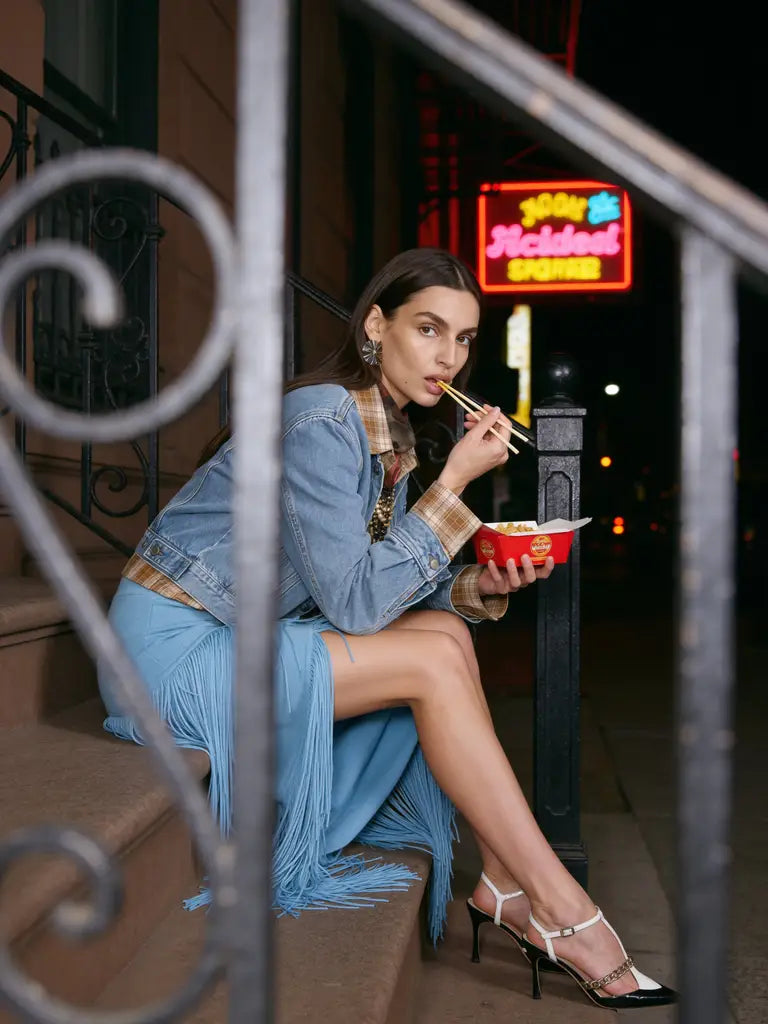
A calendar with three meetings, a late lunch, and a dinner reservation does not call for three different versions of you. It calls for clothing with enough presence to hold its own, and enough intelligence to move through the day without negotiation. Elevated everyday outfits women rely on are built around that balance: distinction without excess, polish without stiffness.
The difference is rarely one dramatic piece worn in isolation. It is the relationship between silhouette, texture, and proportion. A sharply cut jacket changes the posture of a soft knit. A sculptural trouser gives a simple top direction. A considered layer turns the familiar act of getting dressed into a statement in movement.
What Makes an Everyday Outfit Feel Elevated?
Elevation is not about making every morning formal. It is about choosing pieces that make an ordinary setting feel more intentional. The office, the airport lounge, a gallery opening, a table for two: these moments ask for different degrees of expression, but they share a need for ease.
Start with construction. Strong shoulders, a defined waist, a precise trouser line, or a skirt with shape can bring clarity to an outfit before accessories enter the conversation. Architectural clothing does not need to be complicated. Its impact often comes from a clean line held with conviction.
Then consider materiality. Texture creates depth, particularly when color is restrained. Suede against crisp tailoring, dense knitwear against fluid fabric, or a matte surface beside a subtle sheen gives an outfit dimension that reads quietly rather than loudly. This is confidence in contrast.
Finally, leave room for real life. The most useful pieces do not require a perfect setting to make sense. They sit comfortably through a working lunch, travel well enough for a flight from New York to London, and still feel right when the evening runs later than planned. A garment can be structured without feeling restrictive. In fact, that tension is where much of its character lives.
Build Elevated Everyday Outfits for Women Around Shape
A wardrobe becomes easier when it is organized by silhouette rather than by occasion. Instead of asking whether a piece is for work or evening, ask what it does to the line of the body and how it relates to the pieces you already wear.
A tailored jacket is a useful starting point because it creates an immediate frame. Worn over fine knitwear and straight trousers, it feels composed for daytime. Placed over a close-fitting top and a column skirt, it becomes more directional after hours. The jacket remains the same. The proportions around it change.
Trousers deserve equal attention. A pair with a deliberate cut can carry more of the outfit than any decorative detail. Choose a silhouette that establishes shape, whether that means a long, clean leg or a more sculpted profile. Keep the upper half quieter when the trouser has volume or distinct texture. When the trouser is streamlined, introduce presence through outerwear, knitwear, or a more expressive shoe.
Skirts offer another kind of precision. A structured skirt paired with a simple knit creates contrast without looking overly styled. The key is restraint: one element can hold the visual weight while everything else supports it. This is not a rule against personality. It is a way of making personality legible.
The Three-Part Formula: Anchor, Contrast, Ease
The most memorable everyday dressing often has three parts. First, an anchor: the piece that establishes authority. This may be an architectural jacket, a sculptural coat, a well-cut trouser, or suede corset trousers that bring texture and definition to an otherwise pared-back look.
Second, introduce contrast. If the anchor is tailored, soften it with knitwear. If the silhouette is close to the body, add a longer outer layer. If the palette is tonal, let texture do the work. Contrast gives an outfit a point of view, but it should feel considered rather than theatrical.
Third, preserve ease. Ease can be a relaxed sleeve, a softer layer beneath tailoring, a shoe you can actually walk in, or a bag that accommodates the rhythm of your day. Without it, a look may photograph beautifully but fail in practice. Everyday style must earn its place by being lived in.
This formula also prevents the common impulse to add more when an outfit feels unfinished. Often, the answer is not another accessory or a louder color. It may be a better proportion: a shorter knit with a higher-waisted trouser, a longer coat over a leaner base, or a jacket worn with enough simplicity beneath it to remain the focal point.
Create a Palette That Travels
A concentrated palette makes dressing feel less repetitive, not more. Begin with shades that naturally relate to one another, then build interest through surface and shape. Black, ivory, deep brown, charcoal, and soft neutrals can move from Dubai to Paris with very little adjustment because they allow proportion to lead.
That does not mean color has no place. A saturated tone can be powerful when it is given room. The trade-off is versatility: a more distinctive color may be the piece you reach for when you want a clear mood, while neutral foundations carry more combinations across a week. Both deserve a place in a thoughtful wardrobe. The decision depends on whether you are building a daily uniform or adding a deliberate interruption to it.
For frequent travel, repetition becomes an advantage. Bring one outer layer with shape, two complementary bottoms, a compact selection of tops, and a knit that can shift between indoors and out. The result is not a capsule built on deprivation. It is a wardrobe edit with enough range to feel like yourself in Riyadh, London, or a last-minute dinner elsewhere.
Let One Piece Carry the Mood
The pressure to make every element special can make an outfit feel overworked. A stronger approach is to choose one piece that carries the mood, then give it space.
If you are wearing a statement jacket, let the trousers and knit create a calm foundation. If suede corset trousers are the focal point, keep the top clean and the outer layer purposeful. If a skirt has architectural volume, balance it with a more contained upper half. This is how a look stays feminine and commanding at once.
Accessories should support the line rather than compete with it. A defined shoe can sharpen a longer trouser. Jewelry can bring light near the face. But when the clothing has structure, every addition should have a reason. The aim is not minimalism for its own sake. It is visual control.
Dress for the Transition, Not Just the Moment
The most considered wardrobes account for transitions. Morning light, a cold restaurant, an unplanned meeting, a car ride to the airport, an evening invitation. The outfit should not lose coherence when one layer comes off or another goes on.
This is why separates matter. A strong jacket can be removed without leaving the rest of the look unfinished. A refined knit can stand alone indoors, then sit naturally under outerwear. Trousers with shape remain compelling when the day asks you to simplify. HSW approaches this kind of dressing as a wardrobe in motion: clothing designed not simply for the image, but for the life around it.
There is no single formula for looking elevated every day. Some women feel most themselves in a sharp, monochrome line; others need tactile contrast and a more sculptural silhouette. What matters is choosing pieces that make your life feel more coherent, not more complicated. Dress for the woman moving between places, decisions, and rooms. Let the outfit meet her there.
Explore the HSW edit
Discover pieces from HSW that bring these styling ideas into your wardrobe.

