HSW — Journal
How to Style Statement Outerwear
There is a moment, walking into a room in winter, when the coat is the only thing anyone has seen of you yet. Before the rest of the outfit registers, before anyone clocks your shoes or your bag, the coat has already made its case. That is the particular power — and the particular pressure — of outerwear. It is the first sentence of an outfit, and it is usually the only one people read in full.
Most women own outerwear that is quiet on purpose: something neutral, something that will not fight with whatever is underneath. There is a place for that. But a statement coat works on a different logic entirely. It is not there to defer to the rest of the look — it is the look, and everything else is styled around it. Learning to wear one well is less about matching and more about restraint elsewhere, so the coat has room to do its job.
The Statement Coat as Architecture
The best way to think about a statement piece is structural, not decorative. A coat with a strong shoulder, a defined waist, or an oversized drape is doing something architectural to your silhouette before a single accessory gets involved. That is why the most reliable rule for styling one is: let the coat set the shape, and keep everything else simple enough not to compete with it.
This is the whole logic behind HSW’s Outerwear & Coats collection — each piece is built around one strong idea (a removable fur sleeve, a corseted waist, a print, a texture) rather than trying to be everything at once.
Styling the Green Raincoat: Fur Sleeve On vs. Off
The Green Raincoat is the clearest example of a single coat built to do two completely different jobs. With the fur sleeve on, this is an evening coat. Take the sleeve off, and the same coat becomes something you could wear to run errands. The Black and Brown raincoats share the same construction if green is too bold a starting point.
The Leopard Coat: Wearing Print Without It Wearing You
The Hourglass Leopard Coat is cut in faux mink and sculpted around a defined waist, so the silhouette is doing as much work as the pattern. The styling principle that keeps a leopard coat from wearing you is simple: treat the print as the only pattern in the outfit. Solid knitwear underneath, solid trousers, minimal jewelry in warm metals. For a more textured take on the same idea, The Spotted Leopard Jacket applies the same principle in faux horsehair with a hand-selected print.
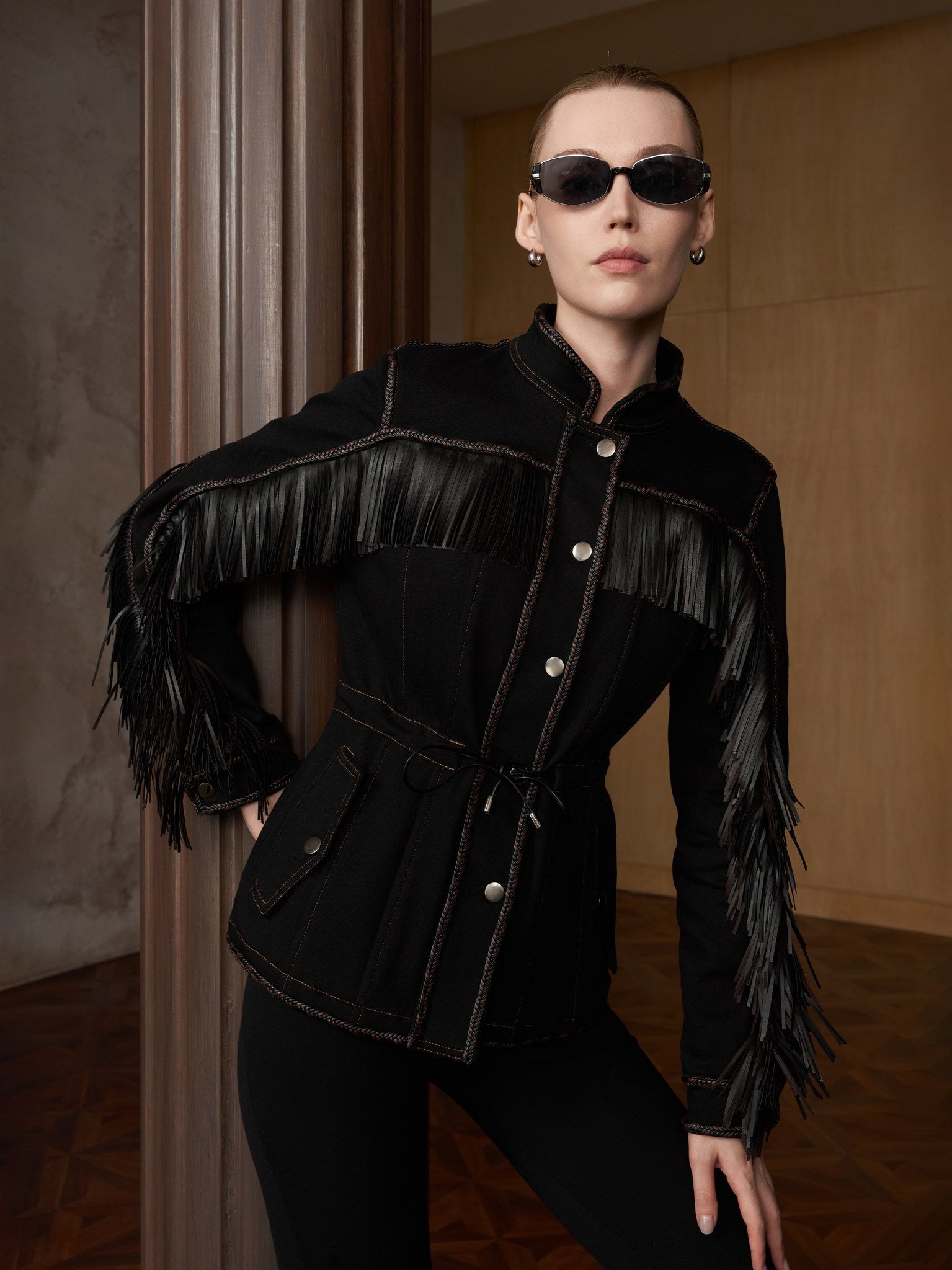
Fringe as Movement: The Riding Jacket with Wide-Leg Denim
The Fringe Riding Jacket is 100% goat leather through the collar, lapel and upper sleeve, with an ombre suede body, a nipped waist, and a self-belt. Fringe sweeps across the hem and sleeve back — and fringe is a detail that only really works in motion. HSW styles this jacket with wide-leg denim and pointed suede pumps: the wide leg gives the fringe room to move without visually competing with it. For a bolder, more directional take on fringe, The Western Fringe Jacket pushes it further with two-tone fringe and internal boning.
Texture as Statement: The Horse Hair Jackets
The Chestnut Jacket is built around a notched lapel that can be worn open or folded up into a stand-collar look — one jacket, two distinct silhouettes. The Contrast Jacket combines two patterns in one piece — a cream-and-brown cowhide-pattern body against dappled, fawn-print sleeves. Because the jacket is already carrying two textures and patterns at once, keep everything else solid.
Outerwear as the Foundation of a Wardrobe
A statement coat is not an accessory to an outfit. It is the outfit’s foundation, and everything else gets built around the decision the coat has already made. Pick the coat, let it set the register of the day, and keep the rest of the look in service of it.
Explore the full Outerwear & Coats collection at HSW.