HSW — Journal
Building a Designer Capsule Wardrobe
Most wardrobes grow by accumulation — a piece bought for a single event here, a trend chased there, until the closet is full and somehow still feels empty of anything to wear. A designer capsule wardrobe works on the opposite principle: fewer pieces, each one chosen because it earns its place, each one built to work harder than a dozen cheaper alternatives combined. It is not about owning less for its own sake. It is about owning on purpose.
The Case for Fewer, Better Pieces
The math behind a capsule wardrobe is simple once you stop thinking about cost per item and start thinking about cost per wear. A coat worn fifty times a season earns its price in a way that ten forgotten fast-fashion pieces never will, no matter how little any one of them cost upfront. But the real argument for fewer, better pieces isn't financial — it's about how a wardrobe actually functions day to day. A closet full of options that don't work together produces decision fatigue, not style. A closet built around a small number of pieces designed to combine with each other produces the opposite: you get dressed faster, and you look more considered doing it.
That's the logic behind building a capsule around a handful of categories — outerwear, knitwear, trousers, one statement piece, one skirt that moves — rather than trying to cover every occasion with a separate outfit. Each category does one job well, and the pieces are chosen to combine with everything else in the capsule, not just with themselves.
The Foundation: One Great Coat
Every capsule wardrobe should be built outward from outerwear, because a coat is the piece that gets seen first and worn longest. The Green Raincoat, Black Raincoat, and Brown Raincoat make a particularly strong capsule anchor because each one is genuinely two coats in one — worn with the removable chinchilla fur sleeve attached for evening, or without it for a cleaner daytime silhouette. That range is exactly what a capsule wardrobe needs from its foundation piece: one purchase that covers two very different registers, rather than needing a separate coat for each.
If you'd rather start the capsule with a shape than a colorway, The Hourglass Leopard Coat works the same way — its waist-defined silhouette holds its shape whether worn open or belted, so the one coat gives you two ways to control how much attention it draws. Either way, the principle is the same: choose the coat first, and choose one with genuine range, because it will set the tone for everything else you build around it. Browse the full Outerwear & Coats collection to compare.
The Knitwear Layer
Knitwear is the connective tissue of a capsule wardrobe — the layer that sits under coats, over trousers, and works alone on milder days. It needs to do more styling work per piece than almost anything else in the closet, which is why it's worth investing here rather than treating it as filler.
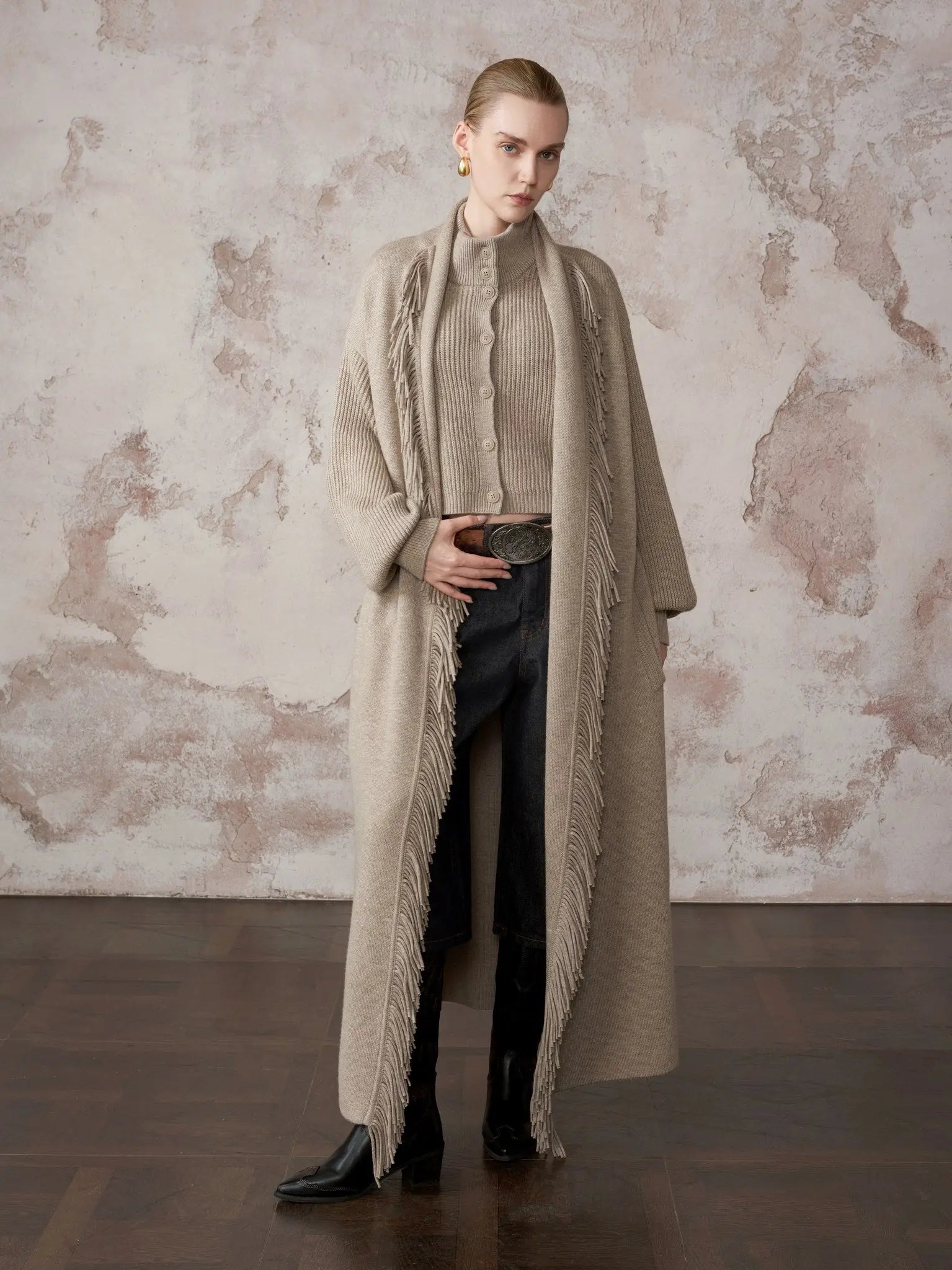
The Merino Wool Cardigan is built for exactly that kind of range: its permanently attached inner funnel neck creates the look of a separate turtleneck layer without needing to style one underneath, so it reads as a complete outfit on its own. Worn open over trousers, it's relaxed; closed, it's a clean monochrome line. The Shirted Cardigan takes the same one-piece-does-two-jobs approach further — a fitted cashmere V-neck body with a permanently attached, dramatic silk collar, so the layered effect of a shirt-under-a-cardigan is built into a single garment. Both pieces solve the same capsule problem: maximum styling versatility from a minimum number of items. See the full Cashmere edit for both.
The Trouser
A capsule wardrobe needs one trouser that can anchor several different outfits, and The Corset-Waist Suede Trouser earns that role through its waistband alone — a caged, adjustable construction with metallic lace panel and back grommet lacing that gives the trouser real presence even styled simply. Because the lace panel is cut individually for each pair, no two are quite alike, which is a detail worth knowing going in.
For a more everyday version of the same silhouette, The Corset-Waist Denim Trouser carries the structured waistband into washed cotton denim — the architecture stays, but the fabric reads casual enough to wear more often, which matters in a wardrobe built around cost-per-wear. A capsule works best when the trouser is versatile enough to pair with both the quiet knitwear layer and the statement piece below, and this silhouette does both. Full range at the Trousers collection.
The Statement Piece: Fringe, Leopard, or Horse Hair
Every capsule wardrobe needs exactly one piece that breaks the rule of restraint — a single item built to be the loudest thing in any outfit it's worn with, so the rest of the wardrobe can stay quiet by comparison. This is the piece you choose last and choose most deliberately, because unlike the coat or the trouser, you only need one.
The Fringe Riding Jacket, cut in goat leather and ombre suede with fringe sweeping the hem and sleeve back, is the western-leaning option — styled with wide-leg denim, it's the jacket that gives an otherwise simple outfit real movement. The Western Fringe Jacket pushes further into that territory with two-tone fringe, whipstitch cord trim, and internal boning for structure. If print is more your register than fringe, The Spotted Leopard Jacket or The Chestnut and Contrast horse hair jackets each build an entire outfit's worth of drama into texture alone. Whichever direction you go, the rule is the same: buy one, wear it against solids, and let it be the single loud decision in any outfit it joins.
The Skirt That Moves
A capsule wardrobe skews toward trousers by default, which is exactly why one skirt built for movement earns its place — it gives the whole capsule a different silhouette option without needing a second trouser. The House Skirt makes the clearest case for this: an asymmetric, tiered fringe hem in fine merino wool, cut so the fringe genuinely falls differently with every step rather than sitting static. It's a skirt designed around motion, which is a different kind of statement than the print or texture pieces above — quieter in color, louder in how it behaves when you walk.
For a complete look rather than a single piece, The Rainfall Set pairs a cropped merino bomber with a three-layer scalloped skirt, both cut from the same ivory wool and calibrated to work as one outfit rather than two separate items that happen to match — a shortcut for anyone who wants the capsule's skirt category and part of its outerwear category solved in a single purchase. Explore the full Skirts collection to compare silhouettes.
A Wardrobe Built on Intention, Not Volume
None of these pieces were chosen because they're trend-driven or because a capsule wardrobe checklist demanded a category be filled. Each one was chosen because it does real styling work — two registers from one coat, a built-in layering effect from one cardigan, an adjustable silhouette from one waistband, genuine movement from one skirt. That's the actual difference between a capsule wardrobe and just a small closet: every piece in it was chosen on purpose, to work with everything else, rather than accumulated one purchase at a time with no plan behind it.
Start with the coat. Build outward from there. The goal was never fewer clothes — it was a wardrobe where every piece has already earned its place before it's ever worn.
Explore the full HSW collection to build your own capsule.