HSW — Journal
Modern Tailoring: The Corset-Waist Trouser
Most tailoring starts at the shoulder or the hem — a jacket built around a lapel, a trouser built around a break. HSW’s corset-waist trousers start somewhere else entirely: the waist. Everything else in the garment, the pleating, the leg width, the pocket placement, is a decision made in response to what’s happening at the waistband, not the other way around. That’s a different way of thinking about tailoring, and it’s worth understanding why it works.
Tailoring That Starts at the Waist
Traditional trouser tailoring treats the waistband as a fairly settled question — a clean, flat closure that exists mostly to hold everything else in place. A corset waistband refuses that premise. It turns the waist into the most engineered part of the garment, borrowing construction ideas — lacing, boning-adjacent structure, adjustable tension — from corsetry and applying them to a trouser. The result is a piece where the waist isn’t just fitted, it’s sculpted, and everything below it is built to answer to that shape.
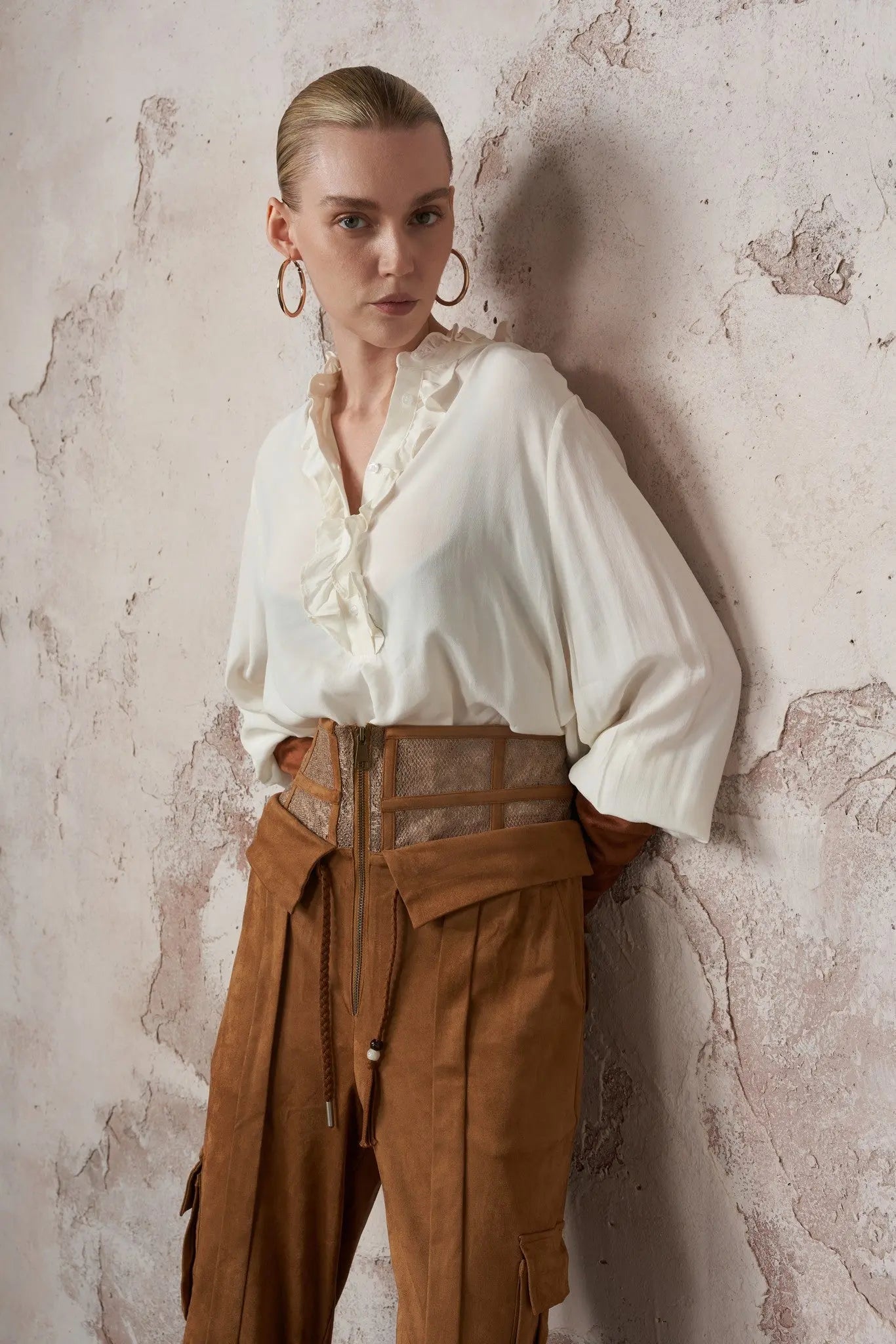
This is the idea behind The Corset-Waist Suede Trouser: a caged, adjustable waistband constructed with real intent, paired with a leg that goes in the opposite direction entirely.
The Corset Waistband: Caged Suede, Grommeted Lacing
The construction detail that makes this trouser read as tailoring rather than just a fitted pant is the waistband itself. Suede strapping frames a metallic lace panel at the front, closed with a zip finished in braided cord and a bead pull — a level of hardware detail usually reserved for outerwear, not trousers. At the back, the waist laces through metal grommets, which means the fit isn’t fixed at the factory; it’s adjustable, the way an actual corset would be, tightened or loosened depending on the day and the rest of the outfit.
One detail worth knowing before buying: because the lace panel is cut individually for each pair, the pattern placement varies slightly from piece to piece. That’s not a flaw to work around — it’s the trade-off of a garment built with more handwork than a standard trouser waistband, and it means the pair you receive is genuinely singular.
For anyone who wants the same silhouette in something more wearable day to day, The Corset-Waist Denim Trouser carries the same structured, paneled waistband logic into 100% cotton washed denim — the corset architecture stays, but the denim wash reads casual enough for daytime in a way the suede version doesn’t try to.
How the Wide Leg Balances the Fitted Waist
A fitted, structured waist paired with an equally fitted leg tends to read as costume rather than tailoring — there’s no visual relief, and the eye has nowhere to land except the waistband itself. That’s why the leg on this trouser goes wide: pleated through the hip, falling to a deep cuffed hem, with structured cargo pockets breaking up the line at the sides.
The wide leg isn’t a separate styling choice bolted onto a corset waistband — it’s the counterweight that makes the waistband legible as architecture instead of just tightness. A fitted waist needs somewhere to release the tension it creates, and a wide, pleated leg is that release. This is the actual mechanic behind why the silhouette works: structure at the waist, volume below it, and the contrast between the two doing more visual work than either element could do alone.
Styling: What to Wear with Corset-Waist Trousers
Because the waistband is already the most detailed part of the outfit, the rest of the styling should work in service of it rather than in competition with it. A simple, fitted top is the most direct way to do that — something that tucks or sits close enough to the waist that the caged lacing stays visible and reads as the focal point, rather than getting buried under a looser silhouette on top.
Knitwear is a natural pairing here, and HSW’s own pieces make the case: The Shirted Cardigan, with its fitted ribbed V-neck body and built-in silk collar, gives the fitted-top effect without needing to layer a separate piece underneath — the collar detail sits above the waistband instead of competing with it. For colder styling, The Merino Wool Cardigan works closed for a clean, monochrome line that keeps all the visual attention at the waist, or open for something more relaxed if the trouser is already doing enough on its own.
On top, outerwear should follow the same logic that governs any statement piece: don’t stack two loud details in one outfit. If the trouser’s waistband is doing the talking, a cleaner jacket — something structured but not equally ornamented — keeps the whole look legible. Save pieces like The Contrast Jacket, The Chestnut Jacket, The Spotted Leopard Jacket, or The Fringe Riding Jacket for trousers with a simpler waist, and let the corset-waist trouser be the one loud decision in the outfit when you wear it.
The Architectural Principle: Structure and Fluidity
What ties all of this together — the caged waistband, the grommeted lacing, the wide pleated leg — is a single design principle: structure and fluidity aren’t opposites, they’re a pairing. A garment that’s rigid everywhere reads as costume. A garment that’s soft everywhere has no shape to speak of. The corset-waist trouser works because it commits fully to structure in one place — the waist — and fully to movement in another — the leg — and lets the tension between the two do the actual styling work.
That’s the broader idea worth taking from this piece, beyond the trouser itself: the most interesting tailoring right now isn’t uniformly fitted or uniformly relaxed. It’s deliberately both, in different places on the same garment, so the eye has somewhere to land and somewhere to release.
Shop The Corset-Waist Suede Trouser and the full Trousers collection at HSW.