HSW — Journal
The Craft Behind HSW’s Faux Fur
Faux fur has spent decades living down its reputation. For a long time, “faux” meant a giveaway — a flat pile, a synthetic sheen, a texture that read as costume the moment it caught the light. That is no longer true of the category at the top end, and it is worth understanding why, because the difference between good faux fur and the version people are still picturing is almost entirely in the details most shoppers never think to check.
Why Faux, and What It Actually Buys You
The case for faux fur used to be framed almost entirely around what it avoids — no animal fur, none of the ethical weight that comes with it. That is still true and still matters to a lot of people. But it undersells what faux fur, done well, actually delivers on its own terms: consistency, durability, and a level of design freedom that real fur doesn’t offer.
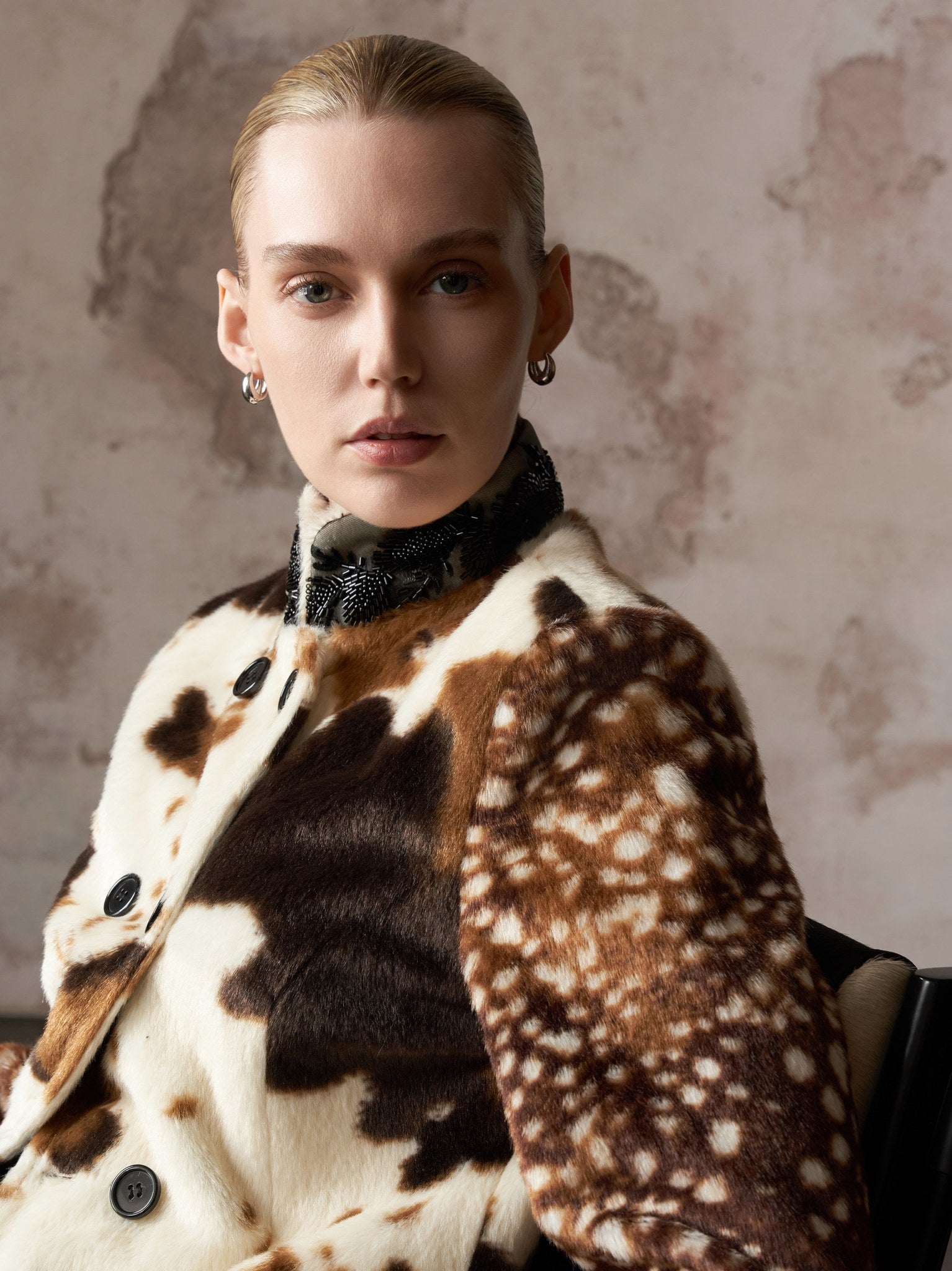
Faux fur can be engineered — pile length, pattern placement, color saturation, and sheen are all decisions a designer gets to make deliberately, rather than working around what a hide provides. That’s how you get something like HSW’s Hourglass Leopard Coat, where the leopard print is placed with intent across a sculpted, waist-defined silhouette — the pattern and the shape were designed together, which is a much harder thing to do consistently with natural fur or hide. It’s also how a piece like The Contrast Jacket can combine two distinct patterns — a cowhide-pattern body against dappled, fawn-print sleeves — in a single, symmetrical, repeatable garment. That kind of pattern-matching is a design decision faux fiber makes possible.
What Makes Luxury Faux Fur Different
The honest answer is that most of it comes down to the pile and the base cloth, not the marketing. A few things separate a coat that reads as genuinely luxurious from one that reads as costume:
Pile length and density. Long-pile constructions — the kind used across HSW’s faux mink and faux horsehair pieces — need enough density that the backing cloth never shows through when the garment moves. Thin, sparse pile is the fastest way to break the illusion, no matter how good the color is.
Fiber quality. Not all synthetic fiber behaves the same way. Better-grade modacrylic and polyester blends hold a duller, more natural sheen and resist the flattening and matting that cheaper fiber develops after a few wears. This is the single biggest gap between a coat that still looks good in year three and one that looks tired after a season.
Construction at the seams and collar. Faux fur hides construction flaws less well than it hides fiber quality — a hand-finished collar or a clean seam where two pile directions meet, like the notched lapel on The Chestnut Jacket, is where cheaper garments usually show their limits first.
Pattern execution, not just print quality. On something like The Spotted Leopard Jacket, the print is hand-selected and applied to long-pile faux horsehair rather than printed flat onto a woven base — which is part of why the pattern has depth and irregularity instead of reading as a uniform repeat.
Faux Fur That Photographs Like Real Fur
The test that matters most for faux fur isn’t how it looks under a boutique’s warm store lighting — it’s how it photographs, because that’s where most people will actually encounter it before they ever touch it. Long-pile fiber with the right sheen catches and scatters light the way natural fur does, rather than flattening into a single glossy plane the way lower-grade synthetic fiber tends to under a camera flash.
How to Care for Faux Fur So It Lasts
Store it hanging, never folded or compressed — pile that’s been crushed for a long stretch can take real effort to fully recover, and repeated compression eventually flattens it for good. Brush the pile gently with a wide-tooth comb or a dedicated fur brush after wear, going with the direction of the pile. Keep it away from direct, sustained heat. Spot-clean rather than machine-wash — faux fur pile does not respond well to agitation. Avoid wearing it in sustained heavy rain if it isn’t the technical, weather-treated kind.
The Pieces
HSW’s faux fur line spans four core pieces, each built around a different idea: the sculpted print of the Hourglass Leopard Coat, the hand-selected pattern of the Spotted Leopard Jacket, the dual-collar construction of The Chestnut Jacket, and the two-pattern contrast of The Contrast Jacket.
Browse the full Fur & Shearling collection at HSW.